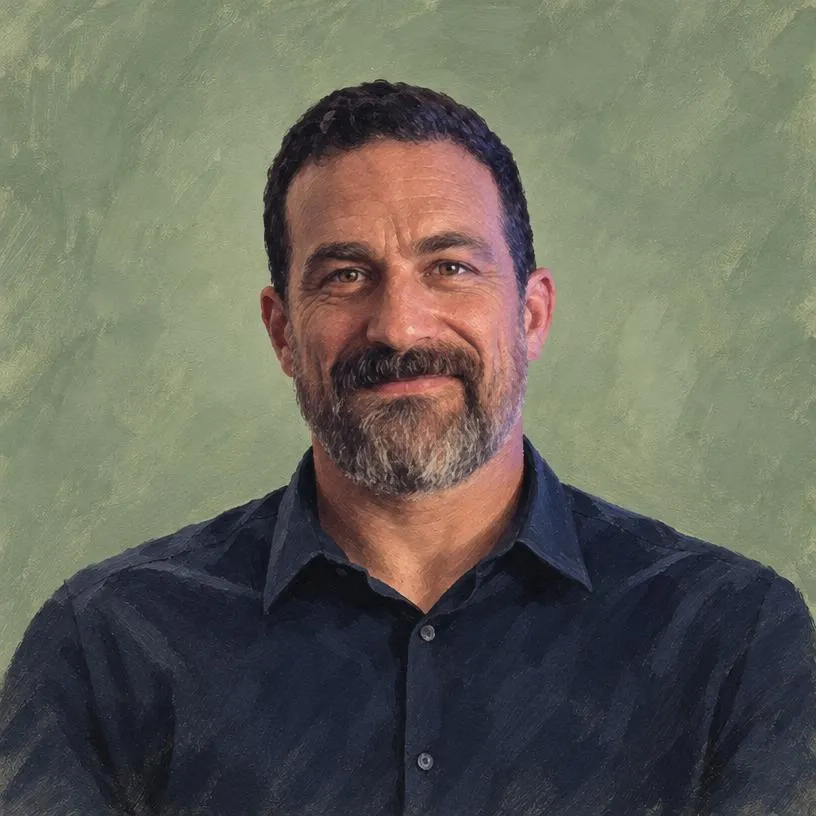
Andrew Huberman
Stanford neuroscientist & Huberman Lab host
Neuroscientist who translates brain and body research into simple, no-cost daily tools for sleep, focus and stress.
“The key is to make your daily habits work for you, not against you.”
Listen to story & lessons
The story
Andrew Huberman grew up in the San Francisco Bay Area, where his father worked as a physicist and engineer. His teenage years were turbulent: after his parents separated he drifted away from school, got into trouble and, by his own account, came close to throwing his future away. A period of therapy and a growing fascination with how the brain shapes behavior helped him turn around, and he went back to his studies with a new seriousness.
He earned his undergraduate degree at the University of California, Santa Barbara, a master's at UC Berkeley and a PhD in neuroscience at UC Davis, followed by postdoctoral research at Stanford. His lab work focused on the visual system: how the eyes connect to the brain, how damaged neural connections might regrow, and how what we see changes our state of alertness, fear and calm. He ran a lab at the University of California, San Diego before returning to Stanford's School of Medicine as a professor of neurobiology.
In 2021 he launched the Huberman Lab podcast with a simple promise: explain the science of the brain and body and offer practical, often free tools people could use the same day. Long episodes on sleep, light, breathing, dopamine and exercise grew into one of the most listened-to health podcasts in the world. His lab's own research, including a study showing that a few minutes of slow, exhale-focused breathing can improve mood and lower arousal, fed directly into the tools he shared.
His rise also brought scrutiny, and critics have challenged some of his claims and his personal conduct. That debate is part of the lesson: science is a conversation, and even good tools should be tested against your own life and the best evidence available. The core of his message has stayed consistent, that small daily behaviors like light, sleep, movement and breathing are powerful levers anyone can pull, and that understanding your own biology gives you more control over how you feel.
Accomplishments
- Earned a PhD in neuroscience from UC Davis and became a professor of neurobiology at Stanford School of Medicine.
- Led research on the visual system, including work on regenerating neural connections between the eye and brain.
- Launched the Huberman Lab podcast in 2021, which became one of the most popular health podcasts in the world.
- Co-authored a 2023 Stanford study showing brief daily breathing practices can improve mood and reduce stress.
Top 10 lessons
- 01
Get morning sunlight in your eyes soon after waking.
Light in the morning helps set your internal clock, which shapes alertness during the day and sleepiness at night. Step outside for five to fifteen minutes soon after waking, longer on cloudy days, without sunglasses if it is safe to do so.
- 02
Anchor your sleep with consistent wake times.
Your body loves rhythm. Waking at roughly the same time each day, even on weekends, makes it easier to fall asleep at night and feel steady during the day. Keep evening light dim to help that rhythm along.
- 03
Use your breath to calm stress in real time.
A 'physiological sigh', two inhales through the nose followed by a long, slow exhale, is one of the fastest ways to bring calm. Exhale-focused breathing slows the heart and can be used anywhere, in the middle of a stressful moment.
- 04
Delay caffeine a little after waking.
Waiting a little after waking before your first coffee may help some people avoid an afternoon energy crash. Treat it as an experiment: notice how you feel, and avoid caffeine late in the day so it does not steal your sleep.
- 05
Move every day with both cardio and resistance training.
The brain and body both benefit from regular movement. Aim for a mix of steady cardio and strength training across the week, and choose activities you can sustain rather than an ideal routine you will abandon.
- 06
Use deliberate cold and heat with care.
Cold showers or plunges and sauna sessions are popular tools for alertness and recovery, but they are optional extras, not foundations. Start gently, avoid them if you have health conditions without medical advice, and never let them replace sleep.
- 07
Protect deep focus in short, intentional blocks.
The brain can only hold intense focus for limited stretches. Work in blocks of about ninety minutes or less, remove your phone from sight and take a real break afterward to reset.
- 08
Let effort itself become the reward.
Dopamine drives motivation, and constant quick rewards can make ordinary effort feel dull. Try to find satisfaction in the work itself, telling yourself the struggle is part of growth, instead of always chasing an outside prize.
- 09
Rest without sleeping to recover your energy.
Short periods of deep rest, such as a guided body scan or 'non-sleep deep rest', can help restore energy and focus during the day. They are not a replacement for sleep but a useful reset when you feel drained.
- 10
Treat relationships and purpose as health tools.
Connection, meaning and good relationships are linked with better mental and physical health. Make time for people who matter to you and for work that feels purposeful, alongside the physical habits.