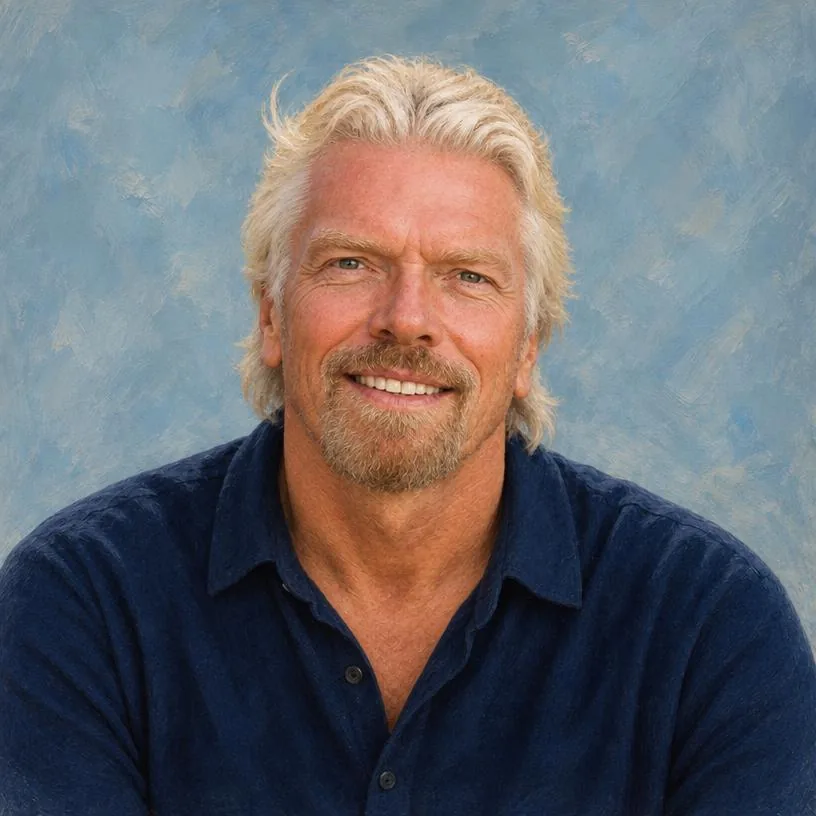
Richard Branson
Virgin founder, entrepreneur & adventurer
Entrepreneur who built Virgin by challenging conventions, trusting people and turning curiosity into a life of adventure.
“Business opportunities are like buses, there's always another one coming.”
Listen to story & lessons
The story
Richard Branson was born in Blackheath, London, in 1950 and grew up in Surrey. School was difficult for him: dyslexia made reading and conventional exams a struggle, and he left formal education at sixteen. But difficulty in a classroom was not the same as a lack of curiosity. He was interested in people, music and the world beyond school, and began building Student magazine with friends. Interviewing public figures and selling advertising gave him a practical education in asking questions, persuading people and bringing an idea to life.
In 1970 he started selling records by mail order, offering young music fans an alternative to expensive high-street shops. A record shop followed, then a recording studio and Virgin Records, founded with Nik Powell in 1972. Mike Oldfield's Tubular Bells, released in 1973, became an extraordinary breakthrough for the new label. Branson discovered that being an outsider could be useful: he could spot customers established businesses overlooked and give unconventional talent a chance. The journey also included serious mistakes, including a tax dispute over record exports that taught him how quickly a shortcut could threaten a business.
Virgin Atlantic launched in 1984, taking the Virgin name into a far more expensive and competitive industry. Branson's approach was to look at the experience through a passenger's eyes and make service feel more personal. Yet ambition created pressure as well as opportunity. In 1992 he sold Virgin Records to Thorn EMI, a painful decision that helped support the airline. Later ventures had mixed results: some grew into lasting businesses, while others, including Virgin Cola, failed to displace powerful competitors. His story is not a formula in which every bold idea succeeds; it is a record of experimentation, difficult trade-offs and learning when to change course.
Over time, the Virgin name expanded across travel, communications and other industries, often through partnerships rather than businesses Branson ran himself. He also pursued ocean and balloon adventures, helped establish Virgin Unite in 2004, and flew on Virgin Galactic's first fully crewed spaceflight in 2021. These milestones made him a public symbol of entrepreneurial adventure, but the practical lesson is quieter: independence depends on capable teams, clear communication and risks you can survive. For Branson, designing a life on your own terms has meant staying curious, delegating responsibility and finding reasons to keep trying after disappointment.
Accomplishments
- Co-founded Virgin Records with Nik Powell in 1972; its 1973 release of Mike Oldfield's Tubular Bells helped establish the label internationally.
- Launched Virgin Atlantic in 1984, bringing the Virgin brand into commercial aviation.
- Received a knighthood for services to entrepreneurship and established the Virgin Unite foundation in 2004.
- Joined Virgin Galactic's first fully crewed spaceflight on July 11, 2021, aboard VSS Unity.
Top 10 lessons
- 01
Start with a real problem, not just a business idea.
Branson's early record business began with a frustration customers already had: music cost too much. Look for a problem you understand, listen to the people living with it, and test whether your idea makes their experience better before committing to a large launch.
- 02
Build your own education when the usual path does not fit.
Leaving school did not end his education. Magazine publishing taught him selling, interviewing and negotiation. When a conventional path does not fit, find another way to learn through practice, mentors and focused study; different strengths still need development.
- 03
Make the customer experience your competitive advantage.
Virgin could not always match established competitors' scale, so it tried to stand out through service. Notice the small moments when customers feel confused, ignored or rushed, and improve those moments rather than relying on a louder marketing promise.
- 04
Delegate responsibility, not just tasks.
A growing business cannot depend on one person making every decision. Choose capable people, agree on the outcome and give them authority to act. Delegation creates freedom only when responsibilities, support and accountability are clear.
- 05
Listen carefully and keep a notebook.
A useful leader listens before assuming they have the answer. Ask people closest to a problem what they see, record ideas and follow up. Paying attention is often more valuable than performing confidence in every conversation.
- 06
Take bold risks while protecting the downside.
Adventure is not the same as risking everything blindly. Before a commitment, estimate the downside, the money and time you could lose, and your exit options. Keep essential obligations protected so one failed experiment does not remove all your choices.
- 07
Learn from failure without becoming defined by it.
Virgin Cola is a reminder that a recognizable name does not guarantee success. After a setback, separate what you could improve from what the market would not support. Keep the lesson without treating either failure or success as your whole identity.
- 08
Look after the people who look after your customers.
People deliver the customer experience. Fair treatment, useful training and trust give a team a better chance to do good work. Supporting employees is not a substitute for business discipline, but it is part of building something people want to sustain.
- 09
Work with your differences, not against them.
Branson has often described dyslexia as shaping how he communicates and delegates. Be honest about what is difficult, ask for help and design workable systems around your strengths. A limitation need not become a verdict on your potential.
- 10
Build a life worth living, not only a business worth owning.
Financial success alone does not decide whether a life feels free. Make room for relationships, health, curiosity and contribution alongside work. The point of building options is to use some of them, not to postpone everything meaningful until a distant finish line.