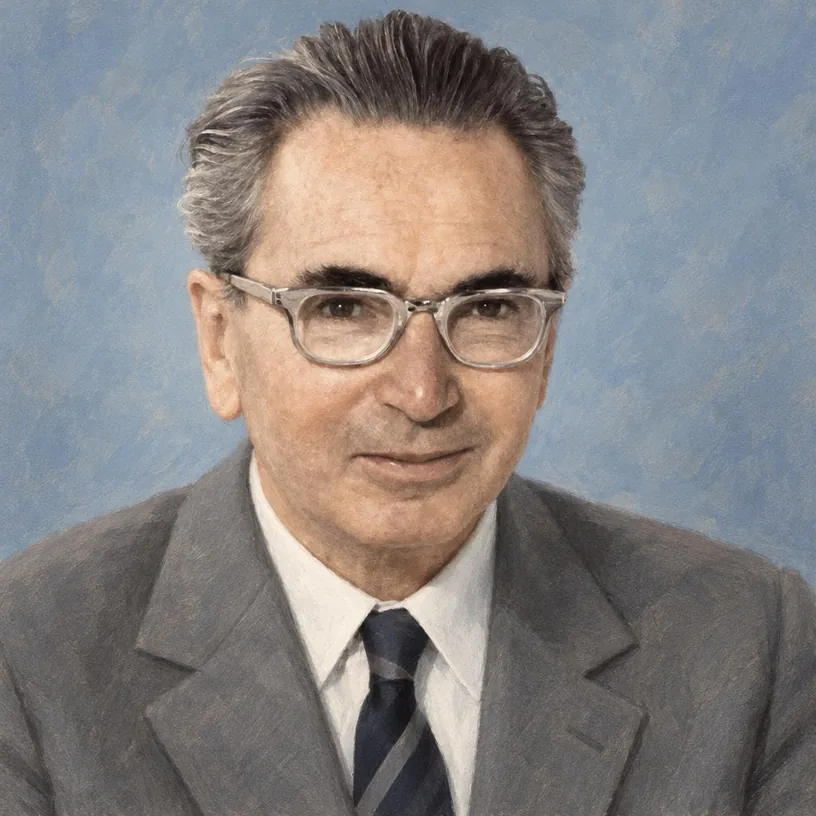
Viktor Frankl
Psychiatrist, Holocaust survivor
Psychiatrist who survived the camps and taught that meaning is our deepest freedom.
“Everything can be taken from a man but one thing: the freedom to choose one's attitude.”
Listen to story & lessons
The story
Viktor Frankl was a promising young psychiatrist in Vienna, already developing his ideas about meaning, when the Nazis took him and his family. He was sent through a series of concentration camps, including Auschwitz. He lost his father, mother, brother and pregnant wife, and the manuscript of his life's work, sewn into a coat, was taken from him on arrival.
In the camps he watched prisoners, himself included, face hunger, cold, forced labor and the threat of death every single day. As a doctor he observed something that would shape the rest of his life: the prisoners who lasted longest were usually not the physically strongest, but those who held on to a purpose, a person to see again, a child to raise, or work left to finish.
After liberation he returned to Vienna and, in nine feverish days, dictated the book that became Man's Search for Meaning. Part memoir of the camps, part statement of his philosophy, it has sold millions of copies and been named among the most influential books ever written. He also founded logotherapy, a school of psychotherapy built on the idea that the search for meaning is the deepest human drive.
He spent the rest of his long life teaching, writing and lecturing around the world. His own survival proved his teaching in the hardest laboratory imaginable: everything can be taken from a person except one thing, the last of the human freedoms, the freedom to choose your attitude in any set of circumstances.
Accomplishments
- Survived Nazi concentration camps, including Auschwitz and Dachau.
- Founded logotherapy, a therapy centered on finding meaning.
- Wrote Man's Search for Meaning, which has sold millions of copies.
- Was professor of neurology and psychiatry at the University of Vienna.
Top 10 lessons
- 01
Your attitude is a freedom no one can take.
Even when circumstances are beyond control, you can choose how you respond.
- 02
Meaning matters more than pleasure.
Pleasure fades, but purpose gives strength and direction through hard times.
- 03
Between stimulus and response lies your choice.
Pause before reacting. That moment gives you the power to choose your response.
- 04
Suffering can find meaning.
Pain cannot always be avoided, but it can lead to growth, courage and compassion.
- 05
Live as if you're living a second time.
Imagine you are living again and can avoid your past mistakes. It helps you act wisely now.
- 06
Success follows when you stop chasing it.
Success and happiness often come as side effects of dedicating yourself to something meaningful.
- 07
Find a 'why' and you can bear almost any 'how'.
A clear reason to keep going helps you endure difficult situations.
- 08
Love is the highest goal we can aspire to.
Love lets us see the best in another person and helps them reach it.
- 09
Responsibility is the other side of freedom.
Freedom is not doing whatever you want. It means owning your choices and their impact.
- 10
Life asks us questions; we answer by how we live.
Instead of asking what life owes you, ask what this moment asks of you.