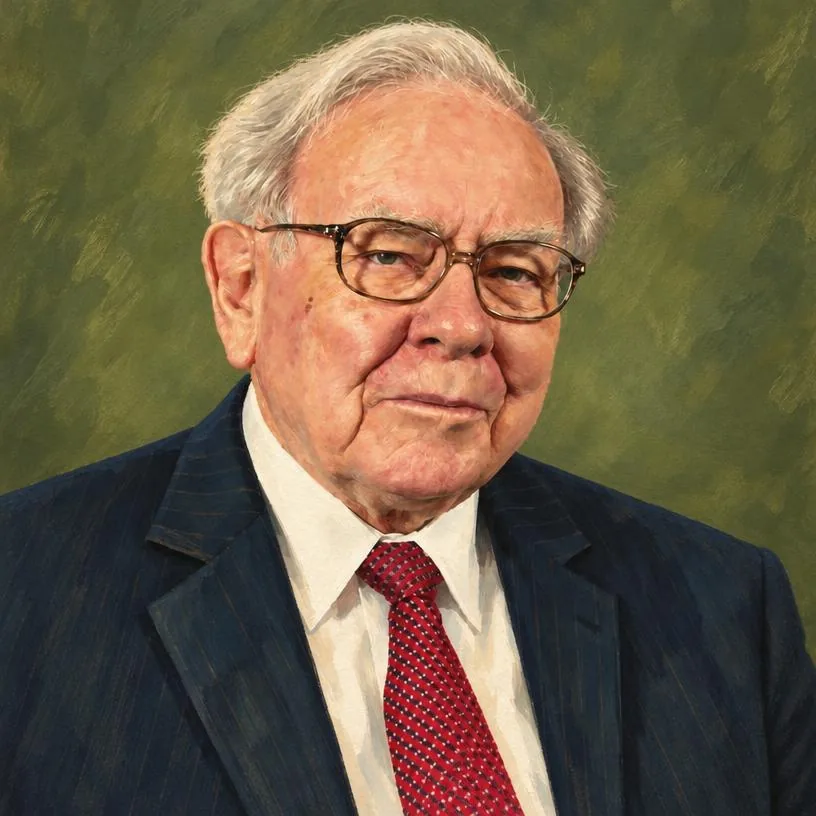
Warren Buffett
Investor, Berkshire Hathaway CEO
Investor who built Berkshire Hathaway into one of the world's most valuable companies by buying wonderful businesses and holding them for decades.
“Someone's sitting in the shade today because someone planted a tree a long time ago.”
Listen to story & lessons
The story
Warren Buffett grew up in Omaha, Nebraska, with numbers in his head from the start. As a boy he delivered newspapers and sold golf balls and chewing gum, filing his first tax return at thirteen and making his first stock purchase at eleven. He watched that first investment rise, sold too early, and watched it keep climbing — a small mistake that taught him a lesson he would repeat for the next eighty years: patience is the whole game.
He studied under Benjamin Graham at Columbia, the father of value investing, who taught him to buy stocks like pieces of businesses rather than tickers on a screen. After working at Graham's firm in New York, Buffett returned to Omaha and launched his own investment partnership in 1956 with money from family and friends, quietly compounding returns year after year.
In 1965 he took control of Berkshire Hathaway, a struggling New England textile maker. The textile business itself failed — an admission he makes freely — but he used it as a shell to buy insurance companies, then wonderful businesses like See's Candies, Coca-Cola and BNSF railroad. With Charlie Munger at his side, his style evolved from buying cheap to buying quality, and Berkshire grew into one of the most valuable companies in the world.
Along the way he learned the lessons his profile teaches: stay inside what you understand, let compounding do the heavy lifting, protect your reputation like a treasure, and know what enough means. In 2010 he co-founded the Giving Pledge with Bill and Melinda Gates and committed nearly his entire fortune to philanthropy, closing the circle on a career that began with a boy and a paper route.
Accomplishments
- Led Berkshire Hathaway since 1965, growing it from a struggling textile mill into one of the world's most valuable companies.
- Compiled an investing record of roughly 20% average annual returns over decades, beating the stock market over the long run.
- Co-founded the Giving Pledge with Bill and Melinda Gates and has pledged and donated the vast majority of his fortune to charity.
- Received the Presidential Medal of Freedom in 2011; his shareholder letters and the Berkshire annual meeting are studied by investors worldwide.
Top 10 lessons
- 01
Never lose money; never forget rule number one.
Protect your capital first. A 50% loss requires a 100% gain to recover, so avoiding big mistakes matters more than chasing big wins.
- 02
Buy wonderful companies at fair prices, not fair companies at wonderful prices.
Quality bought at a fair price compounds for decades. Cheap businesses often keep being cheap, while great ones keep earning.
- 03
Stay inside your circle of competence.
You do not need to know everything — just avoid the things you know you do not understand, and invest inside your own circle.
- 04
Compounding rewards patience above cleverness.
Small yearly gains, left untouched, grow into fortunes. The market transfers money from the impatient to the patient.
- 05
Be fearful when others are greedy, and greedy when others are fearful.
Crowds buy at the top out of greed and sell at the bottom out of fear. Do the opposite and you profit from their panic.
- 06
Price is what you pay; value is what you get.
A low price can still be a bad deal if the business is weak. Compare what you pay to what the business will actually earn.
- 07
Reputation takes a lifetime to build and minutes to ruin.
Trust is a financial asset: it attracts partners, deals and talent. One shortcut can erase decades of good work.
- 08
Keep cash reserves — they are the oxygen of independence.
Cash lets you sleep at night and lets you act when everyone else is frozen. Independence depends on what you have not spent.
- 09
The best investment you can make is in yourself.
Improving your communication, health and judgment pays dividends for life — no market can take those away.
- 10
Say no to almost everything so the best opportunities fit.
Focus is a choice. Decline the good opportunities so you have the time and capital for the great ones.